


 Password Manager
 Identity Theft Protection

 Team / Business
 Enterprise
 Government
 MSP
MSP


Nearly 80 percent of enterprise breaches can be traced to compromised credentials, making passwordless authentication a top priority for every american IT security manager. With cyber threats targeting organizations worldwide, protecting identity has never been more urgent. This guide breaks down the essential steps to assess readiness, select the right methods, and ensure smooth integration so your business can reduce breaches and improve user experience with confidence.
Quick Summary
| Main Insight | Detailed Explanation |
|---|---|
| 1. Assess organizational readiness | Conduct a comprehensive evaluation of your current authentication systems and adaptability for passwordless security. |
| 2. Choose appropriate authentication methods | Evaluate biometric, hardware tokens, and public key cryptography to enhance security while ensuring a user-friendly experience. |
| 3. Integrate with identity management systems | Ensure seamless compatibility with existing systems by using industry-standard protocols and a phased implementation approach. |
| 4. Develop a user enrollment process | Create a structured workflow for enrolling users with clear communication and support to facilitate adoption of new authentication devices. |
| 5. Monitor and verify system performance | Establish a multi-layered monitoring strategy and regularly review performance to address vulnerabilities and ensure usability. |
Step 1: Assess organizational readiness for passwordless adoption
Assessing your organization’s readiness for passwordless authentication requires a comprehensive strategic evaluation of your current security infrastructure and technological capabilities. You’ll want to conduct a thorough analysis of existing authentication systems, potential vulnerabilities, and organizational adaptability to new security protocols.

Begin by conducting a detailed audit of your current authentication landscape. Enterprise security assessments reveal critical insights into password related risks that can help guide your transition strategy. Map out all current authentication touchpoints across your organization including employee login systems, customer access portals, cloud services, and remote work platforms. Identify legacy systems that might require special migration considerations and assess the technical complexity of potential passwordless integration.
Evaluate your technological readiness by examining your current multi factor authentication infrastructure, identity management platforms, and network security configurations. The World Economic Forum recommends analyzing user experience impacts and interoperability challenges during the assessment phase. This means not just looking at technical capabilities but also understanding how passwordless authentication will affect different user groups within your organization. Consider factors like employee technical proficiency, existing security training programs, and potential resistance to change.
Professional Insight: Conduct a pilot test with a small, tech-savvy group in your organization to validate passwordless authentication feasibility and gather practical implementation feedback before full rollout.
Step 2: Select and configure passwordless authentication methods
Selecting and configuring the right passwordless authentication methods will transform your organization’s security approach by replacing traditional password systems with more robust and user friendly technologies. Your goal is to choose methods that balance advanced security with seamless user experience.
Comprehensive academic research highlights multiple passwordless authentication technologies that can meet your security requirements. Begin by evaluating three primary authentication methods: biometric verification, hardware tokens, and cryptographic public key systems. Biometric methods like fingerprint or facial recognition offer strong user convenience and unique identity confirmation. Hardware tokens provide physical authentication through security keys, while public key cryptography enables secure digital verification without traditional passwords.
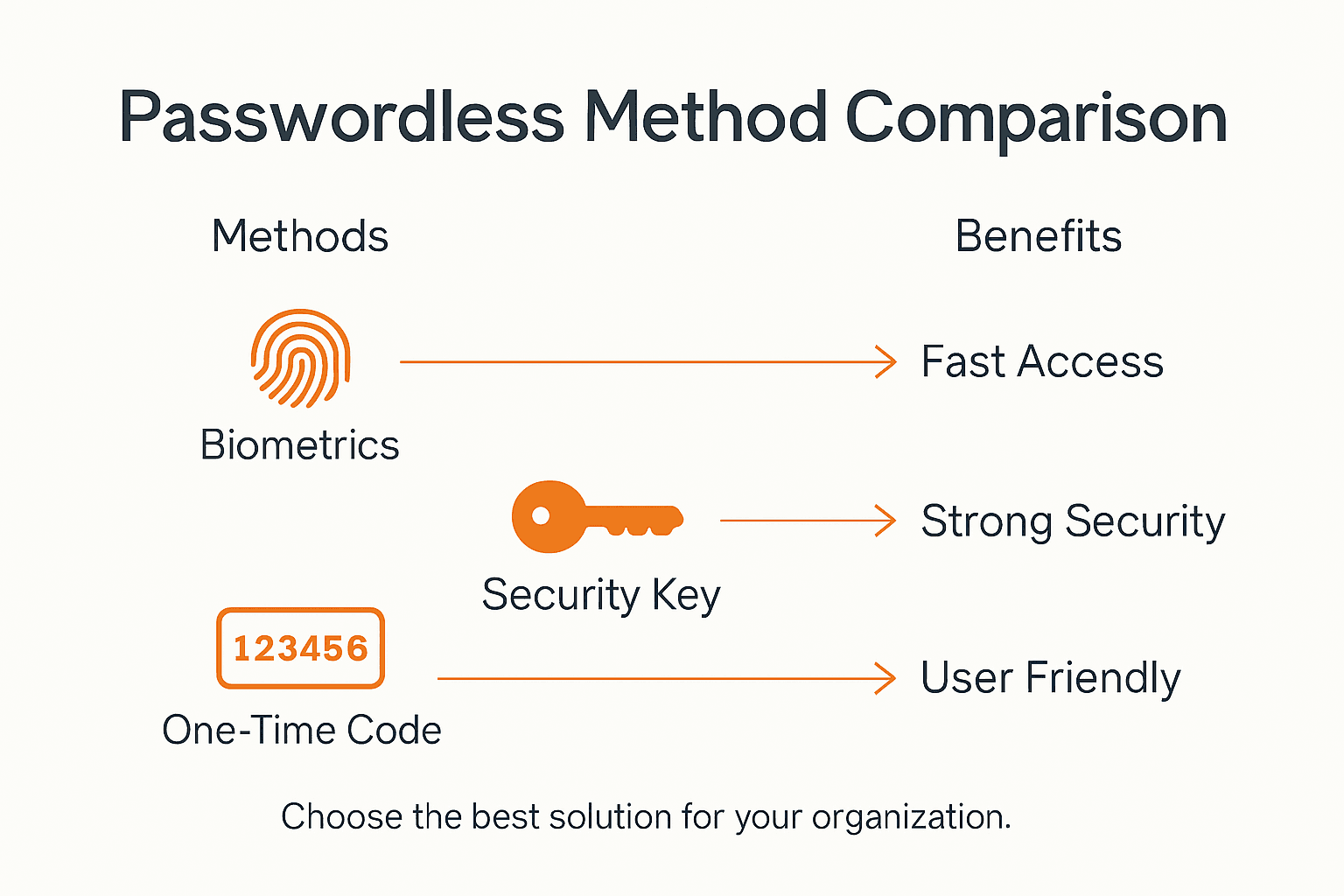
The following table summarizes popular passwordless authentication methods and their business impacts:
| Method | Key Benefits | Typical Challenges |
|---|---|---|
| Biometric Verification | Fast access, unique IDs | Privacy, device dependence |
| Hardware Tokens | Strong security, portable | Loss, replacement costs |
| Public Key Cryptography | Scalable, digital-first | Complexity, legacy systems |
Professional security guidelines recommend carefully aligning authentication solutions with organizational needs to ensure effective implementation. Assess your specific environment by considering factors such as workforce technical proficiency, existing security infrastructure, compliance requirements, and potential user resistance. Look for solutions that offer multifactor capabilities, integrate smoothly with current systems, and provide granular access controls. Prioritize technologies that support multiple authentication pathways and can adapt to different user scenarios across your organization.
Professional Insight: Test selected passwordless methods with a diverse user group to validate usability and identify potential configuration challenges before enterprise wide deployment.
Step 3: Integrate with existing identity management systems
Integrating passwordless authentication with your existing identity management infrastructure requires a strategic approach that ensures seamless compatibility, maintains security standards, and minimizes disruption to current operational workflows. Your primary goal is to create a unified authentication ecosystem that enhances security without compromising user accessibility.
Open authentication initiatives provide critical frameworks for interoperable passwordless deployments, emphasizing the importance of vendor neutral integration standards. Start by conducting a comprehensive audit of your current identity management platforms, mapping out all authentication touchpoints including cloud services, on premises systems, and hybrid environments. Identify potential integration points and compatibility requirements for your chosen passwordless technologies. Focus on solutions that support industry standard protocols like Security Assertion Markup Language (SAML), OpenID Connect, and OAuth 2.0 to facilitate smoother system interactions.
National cybersecurity roadmaps recommend a phased approach to identity management transformation, which involves careful planning and incremental implementation. Prioritize creating middleware or API layers that can translate between your existing identity management systems and new passwordless authentication methods. This approach allows for gradual migration, reducing potential disruptions and providing flexibility to adjust your implementation strategy. Engage with your IT security teams to develop comprehensive integration protocols that maintain granular access controls, support comprehensive logging, and enable centralized authentication management across different platforms and user groups.
Professional Insight: Establish a dedicated integration testing environment that mirrors your production infrastructure to validate passwordless authentication compatibility before full scale deployment.
Step 4: Enroll users and provision authentication devices
Successfully enrolling users and provisioning authentication devices is a critical phase in your passwordless authentication implementation that requires careful planning, clear communication, and a structured approach to ensure smooth user adoption and minimal disruption.
Enterprise passwordless enrollment strategies emphasize secure identity verification and comprehensive user education, creating a foundational process for introducing new authentication methods. Begin by developing a detailed enrollment workflow that includes multiple verification steps such as confirming existing user credentials, conducting identity validation through multiple channels, and providing clear documentation about the new authentication process. Create personalized communication packages for different user groups within your organization, explaining the benefits, technological changes, and specific steps required for device registration and setup.
Government authentication frameworks recommend phased user enrollment with strong support mechanisms to build user confidence and ensure successful technology transition. Implement a tiered rollout strategy where initial phases target technically proficient user groups who can provide feedback and help refine the process. Develop comprehensive support resources including video tutorials, step by step guides, and dedicated helpdesk support to assist users during device registration. Ensure your provisioning process includes secure device distribution methods, clear activation instructions, and robust backup authentication options to maintain operational continuity during the transition.
Professional Insight: Create a user feedback channel during the enrollment process to quickly identify and resolve potential configuration or usability challenges.
Step 5: Verify implementation and monitor ongoing performance
Verifying the implementation and establishing a robust monitoring framework for your passwordless authentication system ensures continued security effectiveness, identifies potential vulnerabilities, and maintains optimal user experience across your organization.
Federal cybersecurity guidelines recommend comprehensive verification procedures for securing identity tokens and authentication systems, emphasizing the critical nature of continuous performance assessment. Develop a multi layered monitoring strategy that includes real time tracking of authentication attempts, comprehensive logging of access events, and detailed analysis of user interaction patterns. Implement automated alert systems that can quickly detect anomalies such as unusual login attempts, repeated authentication failures, or potential unauthorized access attempts. Create performance dashboards that provide granular insights into system health, user adoption rates, and potential security risks.
Academic research highlights the importance of tracking key performance indicators in passwordless authentication deployments, suggesting a holistic approach to ongoing system evaluation. Conduct periodic security audits that assess the effectiveness of your authentication methods, validate token management processes, and ensure compliance with organizational security policies. Establish a continuous feedback loop that involves IT security teams, user support groups, and a representative sample of end users to gather insights about system performance, usability challenges, and potential improvements. Regularly review and update your authentication protocols to address emerging security threats and incorporate technological advancements in passwordless authentication technologies.
Here is a quick reference of key performance indicators for passwordless authentication systems:
| KPI | What It Measures | Why It Matters |
|---|---|---|
| Authentication Success Rate | User access reliability | Detects usability issues |
| Number of Failed Attempts | Security threat signals | Uncovers attack patterns |
| System Uptime | Availability | Ensures business continuity |
| User Adoption Rate | Engagement level | Guides future improvements |
Professional Insight: Schedule quarterly comprehensive reviews of your passwordless authentication system to proactively identify and address potential security or performance gaps.
Secure Your Organization’s Future with Passwordless Authentication Today
Transitioning to passwordless authentication is essential to overcoming challenges like complex user enrollment, system integration, and ongoing security monitoring highlighted in the Passwordless Authentication Setup Guide for Secure Access. If you seek an effortless way to eliminate password vulnerabilities, enhance user experience, and maintain robust identity management, adopting cutting-edge solutions is the next step.

Empower your business with LogMeOnce’s comprehensive cybersecurity platform that combines passwordless multi-factor authentication, secure single sign-on, and cloud-based encryption to safeguard your digital assets. Don’t wait until risks escalate. Visit LogMeOnce Solutions now to explore tailored plans for enterprises and government agencies. Start your free trial today and take full control of secure access with confidence.
Frequently Asked Questions
What steps should I follow to assess my organization’s readiness for passwordless authentication?
Assess your organization’s readiness by conducting a thorough audit of your current authentication systems, including evaluating existing vulnerabilities and adaptability to new protocols. Create a detailed map of all authentication touchpoints and identify any legacy systems that may require special migration, aiming to complete your assessment within a few weeks.
How do I select the right passwordless authentication methods for my organization?
To select the best passwordless authentication methods, evaluate the strengths and weaknesses of options like biometric verification, hardware tokens, and public key cryptography. Choose methods that balance security and user experience, and aim to conduct test trials with a diverse user group to refine your selections.
What is the best way to integrate passwordless authentication with existing identity management systems?
Integrate passwordless authentication by conducting an audit of your current identity management platforms and identifying compatibility requirements. Prioritize using industry-standard protocols to ensure smooth interactions, and establish a testing environment to validate compatibility before deploying new systems.
How can I effectively enroll users and provision authentication devices?
Develop a structured enrollment workflow that includes multiple verification steps for users. Create personalized communication materials to explain the new processes and offer support resources, targeting completion of user enrollment within a defined timeframe to foster confidence in the new system.
What metrics should I track to monitor the performance of passwordless authentication?
Track key performance indicators such as authentication success rate, the number of failed attempts, system uptime, and user adoption rate. Set up a comprehensive monitoring strategy to assess these metrics regularly, ensuring that system performance remains optimal and adjustments can be made within a quarterly review cycle.


