


 Password Manager
 Identity Theft Protection

 Team / Business
 Enterprise
 Government
 MSP
MSP


Over ninety percent of mid-sized enterprises target stronger authentication protocols, yet misconceptions about authentication tokens still hold many teams back. With the rise of sophisticated cyber threats across American, Canadian, and European organizations, understanding what tokens actually do is critical for IT security managers. This guide breaks down token concepts, clarifies common misunderstandings, and offers real-world strategies to improve identity security using multi-factor authentication.
Key Takeaways
| Point | Details |
|---|---|
| Authentication Tokens Are Dynamic | They represent programmatic, time-bound credentials that adapt to security needs and are essential for establishing digital trust. |
| Different Token Types Fulfill Various Roles | Tokens like Bearer, Access, Refresh, and ID tokens each serve specific purposes to enhance security in digital environments. |
| MFA Enhances Security with Tokens | Authentication tokens are vital in multi-factor authentication systems, providing layered verification that goes beyond traditional methods. |
| Effective Token Management is Crucial | Organizations must implement robust token management strategies that include encryption, monitoring, and lifecycle protocols to mitigate security risks. |
Authentication tokens—definition and misconceptions
Authentication tokens represent secure digital credentials used to verify a user’s identity across computer systems and networks. Unlike simplistic assumptions, these tokens are not limited to physical devices but encompass a sophisticated range of digital authentication mechanisms. Comprehensive digital identity guidelines from the National Institute of Standards and Technology clarify that tokens serve as dynamic, cryptographically protected mechanisms for establishing digital trust.
At their core, authentication tokens are programmatic representations of verified identity credentials. They can manifest in multiple formats: software applications, hardware devices, cryptographic certificates, or temporary digital passes. Contrary to common misconceptions, these tokens are not static or permanent credentials. Instead, they are typically time-bound, revocable, and designed with robust security protocols to prevent unauthorized access. The tokens function as digital passports, carrying encrypted information that validates a user’s right to access specific digital resources.
The complexity of authentication tokens extends far beyond simple username and password combinations. Modern tokens incorporate advanced security features like time-based one-time passwords, biometric signatures, and multifactor authentication protocols. They can be generated dynamically, expire after short intervals, and include sophisticated encryption that makes them resistant to traditional hacking techniques. Security professionals recognize these tokens as critical components in creating layered, adaptive authentication systems that respond intelligently to potential security threats.
Pro tip: Implement a token rotation strategy that automatically refreshes authentication credentials at regular intervals to minimize potential security vulnerabilities.
Major types of authentication tokens
Authentication tokens encompass several distinct types, each designed to serve specific security requirements in digital systems. Comprehensive guides on authentication technologies reveal a complex landscape of token classifications that go beyond simple credential verification.
Bearer tokens represent one of the most common authentication mechanisms, functioning as portable credentials that grant access to protected resources. These tokens operate on a simple principle: whoever possesses the token can access the associated system. They are typically used in web applications and API authentication frameworks, requiring robust security measures to prevent unauthorized interception. Unlike more complex token types, bearer tokens rely heavily on secure transmission protocols to maintain their integrity.
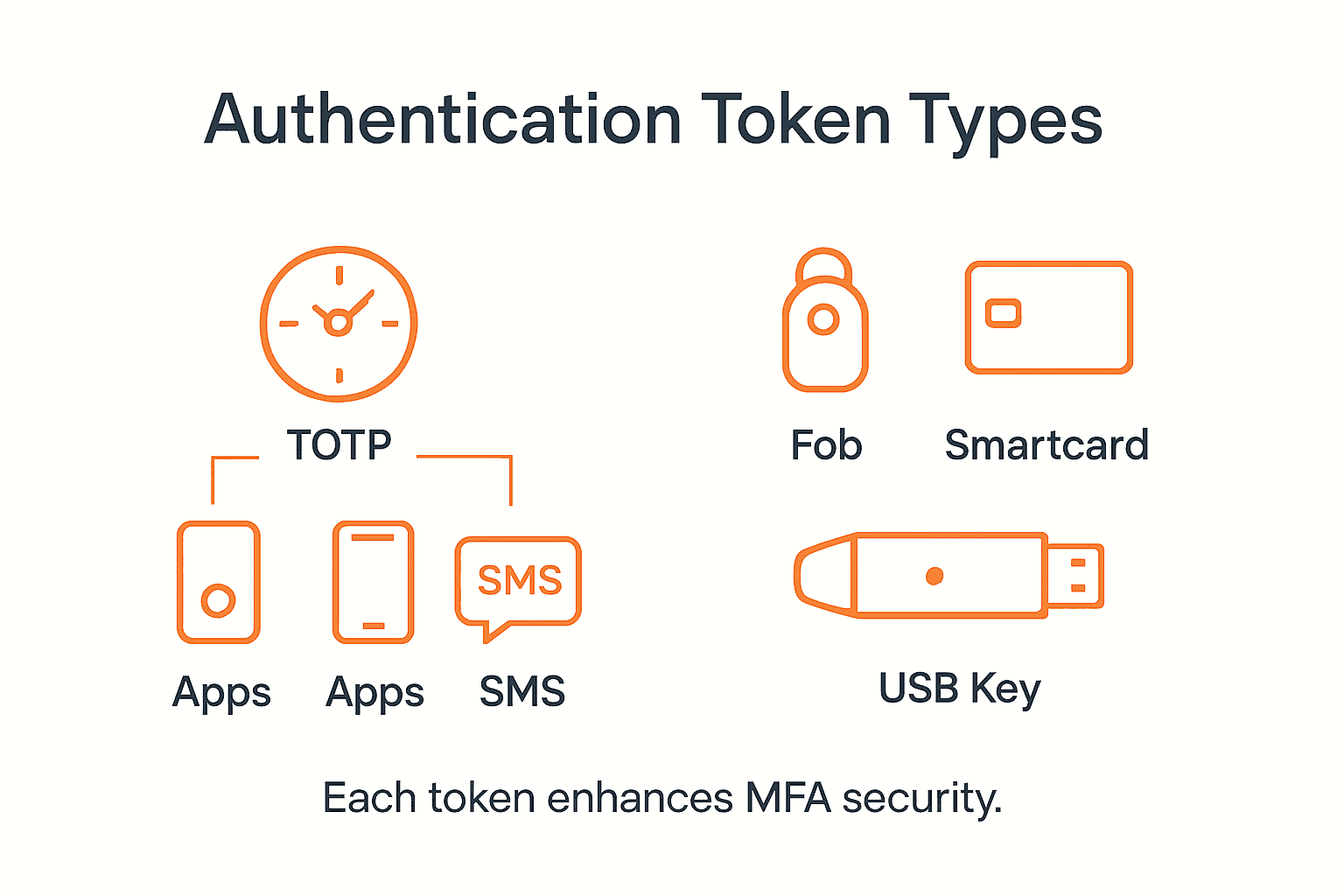
Moreover, the authentication token ecosystem includes specialized variants like access tokens, refresh tokens, and ID tokens. Access tokens provide time-limited permissions for specific system interactions, while refresh tokens enable the generation of new access credentials without requiring full reauthentication. ID tokens, often used in OpenID Connect protocols, carry essential user profile information and help establish user identity across different digital platforms. Each token type incorporates unique cryptographic signatures and expiration mechanisms designed to minimize potential security vulnerabilities.
The table below summarizes the main types of authentication tokens and their distinctive roles:
| Token Type | Main Function | Typical Use Case |
|---|---|---|
| Bearer Token | Grants access to protected resources | Web APIs and apps |
| Access Token | Enables temporary access based on permissions | OAuth-based systems |
| Refresh Token | Obtains new access tokens without reauthenticating | Long-lived sessions |
| ID Token | Verifies and relays user identity information | OpenID Connect SSO |
Pro tip: Always implement token encryption and use secure HTTPS channels to prevent potential token interception during transmission.
How authentication tokens work in MFA
Multi-factor authentication (MFA) leverages authentication tokens as critical components in creating robust identity verification systems. Comprehensive National Institute of Standards and Technology guidelines outline how these tokens function as sophisticated cryptographic proof mechanisms that dramatically enhance security beyond traditional single-factor authentication methods.

In MFA frameworks, authentication tokens operate as dynamic, intelligent credentials that interact with multiple verification layers. When a user attempts to access a secure system, the token generates a unique cryptographic signature that must be validated against predefined security parameters. This process typically involves combining something the user knows (like a password), something the user possesses (like a hardware token), and potentially something inherent to the user (such as biometric data). The token acts as a sophisticated digital passport, dynamically generating time-sensitive credentials that expire quickly to minimize potential security vulnerabilities.
The technical complexity of authentication tokens in MFA extends far beyond simple credential exchange. These tokens incorporate advanced encryption algorithms, generate one-time passwords, and can adapt to contextual security requirements. They might utilize techniques like geolocation verification, device fingerprinting, and behavioral analysis to create a multilayered authentication ecosystem. Some tokens can even detect anomalous access patterns, automatically triggering additional verification steps or temporarily blocking access when suspicious activities are detected.
Pro tip: Implement adaptive authentication policies that dynamically adjust token verification complexity based on perceived risk levels and user behavior patterns.
Enterprise use cases and deployment
Enterprises are increasingly adopting advanced authentication token strategies to secure complex digital infrastructures. National Institute of Standards and Technology guidelines provide comprehensive frameworks for implementing robust token-based security across diverse organizational environments, addressing critical challenges in identity and access management.
Single sign-on (SSO) represents a pivotal enterprise deployment scenario for authentication tokens. In this model, organizations implement centralized token management systems that allow employees to access multiple applications and resources using a single authenticated session. This approach dramatically reduces password fatigue, minimizes security risks associated with credential management, and streamlines user authentication processes across complex technological ecosystems. Tokens in SSO environments are typically designed with granular permission controls, enabling IT administrators to define precise access levels for different user roles and organizational hierarchies.
Federated identity management emerges as another critical enterprise use case, particularly for organizations with distributed workforce and cloud-based infrastructure. Authentication tokens facilitate secure identity verification across different domains, enabling seamless collaboration between internal systems and external partner networks. These tokens incorporate sophisticated encryption mechanisms that support cross-platform authentication, allowing secure access from various devices and geographic locations while maintaining strict compliance with organizational security policies. Advanced token strategies can integrate contextual authentication factors like device recognition, geolocation tracking, and behavioral analysis to create adaptive security environments that respond dynamically to potential risks.
Here’s a comparison of SSO and federated identity management for enterprise deployments:
| Approach | Key Advantage | Typical Environment |
|---|---|---|
| Single Sign-On (SSO) | Simplifies access across systems | Internal enterprise applications |
| Federated Identity | Enables cross-domain access | Multi-organization/cloud platforms |
Pro tip: Design authentication token strategies with modular architectures that allow incremental security upgrades and support seamless integration with emerging technological platforms.
Security risks and token management practices
Authentication tokens, while critical to secure digital systems, present complex security challenges that demand sophisticated management strategies. National Institute of Standards and Technology guidelines outline comprehensive approaches for mitigating potential vulnerabilities associated with token-based authentication systems, emphasizing the importance of proactive risk management.
Token theft represents one of the most significant security risks in modern authentication frameworks. Malicious actors can potentially intercept tokens through various techniques including network interception, social engineering, and advanced phishing attacks. These stolen tokens grant unauthorized access to protected systems, potentially compromising entire organizational networks. Sophisticated token management practices must incorporate multiple defensive layers, including encrypted transmission protocols, short-lived token lifecycles, and real-time monitoring systems that can detect and immediately neutralize suspicious access attempts.
Effective token management requires a holistic approach that integrates technical controls with robust organizational policies. This involves implementing comprehensive token lifecycle management protocols that include secure token generation, time-limited credential issuance, automatic expiration mechanisms, and immediate revocation capabilities. Advanced organizations are increasingly adopting adaptive authentication models that continuously assess contextual risks, dynamically adjusting token validation requirements based on factors like user behavior, device reputation, and geographic access patterns. These intelligent systems can automatically escalate authentication challenges or block access when anomalous activities are detected.
Pro tip: Implement a centralized token management system with automated rotation and real-time threat detection to minimize potential security vulnerabilities.
Strengthen Your Security with Advanced Authentication Token Solutions
The complex challenges of managing authentication tokens and implementing secure multi-factor authentication highlighted in the article underscore the urgent need for robust and adaptive identity protection. If you want to eliminate risks like token theft, implement token rotation, and establish seamless single sign-on systems your organization deserves a solution designed to deliver strong cryptographic verification with ease of use. LogMeOnce understands that today’s digital environments demand more than just basic tokens — they require intelligent, time-sensitive credentials with layered security to protect sensitive data and prevent unauthorized access.

Discover how LogMeOnce’s comprehensive cybersecurity suite empowers businesses and individuals to conquer authentication vulnerabilities while embracing passwordless MFA, encrypted cloud storage, and dynamic token management. Don’t wait for a security breach to test your defenses take control now and experience the power of cutting-edge identity management at LogMeOnce. Start your free trial today and move beyond theory into proven protection.
Frequently Asked Questions
What are authentication tokens?
Authentication tokens are secure digital credentials used to verify a user’s identity in computer systems and networks. They are dynamic and time-bound, functioning as digital passports that carry encrypted information to validate access rights.
How do authentication tokens enhance multi-factor authentication (MFA)?
In MFA systems, authentication tokens act as dynamic credentials that add layers of security. They combine multiple verification factors, such as passwords and biometric data, generating unique cryptographic signatures to ensure robust identity verification.
What are the different types of authentication tokens?
Authentication tokens come in various types, including bearer tokens, access tokens, refresh tokens, and ID tokens. Each type serves a distinct purpose in security protocols, such as granting temporary access or verifying user identity information.
How can organizations effectively manage authentication tokens?
Organizations should adopt comprehensive token management strategies that include secure token generation, short-lived token lifecycles, and real-time monitoring to detect suspicious activities. Implementing centralized token management systems can also enhance security by automating token rotation and revocation.
Recommended


