


 Password Manager
 Identity Theft Protection

 Team / Business
 Enterprise
 Government
 MSP
MSP


Credential stuffing attacks now account for more than 80% of web application breaches in the American market, yet many IT security teams underestimate how quickly stolen passwords can expose sensitive assets. As enterprises expand digital services globally, password reuse across platforms allows cybercriminals to exploit even a single compromised account. This overview dispels common misconceptions and gives IT leaders the insights needed to recognize why credential stuffing is a major risk, not just for American organizations but for every enterprise seeking to safeguard valuable data.
Key Takeaways
| Point | Details |
|---|---|
| Credential Stuffing vs. Brute Force | Credential stuffing uses stolen credentials from data breaches, unlike brute force, which generates random guesses. This makes credential stuffing more effective due to the use of real data. |
| High Success Rate | Credential stuffing can have a success rate of 0.1% to 2%, posing a significant risk to organizations with many accounts using the same credentials. |
| Impacts on Enterprises | Successful attacks can lead to financial loss, reputational damage, and regulatory penalties, emphasizing the need for strong security measures. |
| Effective Defense Strategies | Employ multi-factor authentication, rate limiting, and continuous credential monitoring to mitigate risks associated with credential stuffing. |
Credential Stuffing Defined and Common Misconceptions
Credential stuffing represents a sophisticated cyber attack strategy that exploits widespread password reuse across digital platforms. Unlike traditional password guessing techniques, this method leverages stolen credential sets obtained from previous data breaches to systematically compromise user accounts. Credential stuffing attacks operate through automated systems that rapidly test leaked username and password combinations across multiple websites.
A critical misconception is equating credential stuffing with brute force attacks. While brute force techniques randomly generate password combinations, credential stuffing specifically uses actual stolen credentials from prior security breaches. This distinction makes credential stuffing particularly dangerous, as attackers are working with genuine user login information rather than randomly generated password attempts. The automated nature of these attacks relies on credential reuse across different platforms, allowing cybercriminals to exploit users who maintain identical passwords across multiple services.
Here’s a comparison of credential stuffing versus brute force attacks to clarify their key differences:
| Criteria | Credential Stuffing | Brute Force Attack |
|---|---|---|
| Source of credentials | Stolen from breaches | Randomly generated guesses |
| Success rate | 0.1% – 2% | Significantly lower |
| Attack method | Automated, uses real data | Automated/manual, tries all possibilities |
| Main vulnerability exploited | Password reuse | Weak or predictable passwords |
| Typical impact | High for reused credentials | Depends on password strength |
The scale and impact of credential stuffing are significant. Cybersecurity research indicates that approximately 0.1% to 2% of automated login attempts successfully compromise accounts, translating to potentially thousands of unauthorized access instances for large organizations. Attackers utilize sophisticated tools that can test millions of credential combinations within minutes, making this attack method both efficient and challenging to detect.
Pro Tip – Credential Defense: Implement robust multi factor authentication and encourage unique passwords for each digital service to dramatically reduce the risk of successful credential stuffing attacks.
How Credential Stuffing Attacks Work
Credential stuffing attacks represent a systematic and calculated approach to unauthorized system access, utilizing sophisticated digital infrastructure to exploit password vulnerabilities. Attackers begin by acquiring large collections of stolen usernames and passwords through dark web marketplaces, previous data breaches, or underground cybercrime forums. These credential databases are often obtained from massive corporate security incidents where user login information has been compromised and subsequently leaked.

The attack methodology involves automated scripts and specialized software tools that can rapidly test stolen credentials across hundreds or thousands of websites simultaneously. These credential testing bots are programmed to mimic human login behavior, using techniques like randomized IP addresses, rotating user agents, and carefully timed login attempts to evade standard detection mechanisms. Attackers leverage the unfortunate reality that approximately 53% of people reuse passwords across multiple platforms, creating a high probability of successful account penetration.
Once credential testing scripts identify valid login combinations, attackers can execute numerous malicious actions. These might include financial fraud, identity theft, data exfiltration, or establishing persistent unauthorized access to corporate networks. Some cybercriminal groups even sell successfully compromised accounts on underground markets, creating an entire economic ecosystem around stolen credential exploitation. The speed and scalability of these attacks make them particularly dangerous, with some advanced botnets capable of testing millions of credential combinations within minutes.
Pro Tip – Attack Prevention Strategy: Implement comprehensive password rotation policies, utilize multi-factor authentication, and deploy advanced anomaly detection systems that can identify and block automated login attempts from suspicious sources.
Tools and Techniques Used by Attackers
Credential stuffing tools represent a sophisticated ecosystem of automated software designed to exploit digital security vulnerabilities. Attackers leverage off-the-shelf automation platforms like Sentry MBA, Account Hitman, Vertex, and Apex that provide comprehensive infrastructure for conducting large-scale login compromise attempts. These specialized tools are engineered to bypass traditional security mechanisms by mimicking legitimate user behaviors and systematically testing stolen credential combinations across multiple digital platforms.
The technical arsenal of credential stuffing attackers includes advanced techniques for obfuscating their digital footprint. Cybercriminals deploy complex proxy networks that rotate IP addresses, utilize sophisticated bot management tools, and implement machine learning algorithms to randomize login attempt patterns. These methods allow attackers to circumvent standard detection mechanisms by creating login traffic that appears indistinguishable from authentic user interactions. Sophisticated scripts can adjust login attempt speeds, simulate realistic user agents, and even incorporate human-like interaction patterns to evade sophisticated cybersecurity filters.
Moreover, attackers have developed intricate marketplaces and underground economies that facilitate credential exchange and tool development. These digital black markets enable cybercriminals to purchase comprehensive credential databases, rent specialized attack infrastructure, and share sophisticated automation scripts. Some advanced groups even offer subscription-based services that provide continuously updated credential lists, proxy rotation services, and custom-built attack frameworks, transforming credential stuffing into a sophisticated, industrialized cybercrime model.
Pro Tip – Defensive Reconnaissance: Continuously monitor dark web platforms and underground forums to understand emerging attack tools and proactively update your organization’s defensive strategies against evolving credential stuffing techniques.
Risks for Enterprises and Real-World Impacts
Credential stuffing poses an existential threat to enterprise security, with potentially catastrophic financial and reputational consequences. One global retailer experienced millions in monthly losses due to systematic account compromises, highlighting the devastating economic impact of these attacks. Beyond direct monetary losses, enterprises face complex challenges including operational disruption, customer trust erosion, regulatory compliance risks, and potential long-term brand damage.
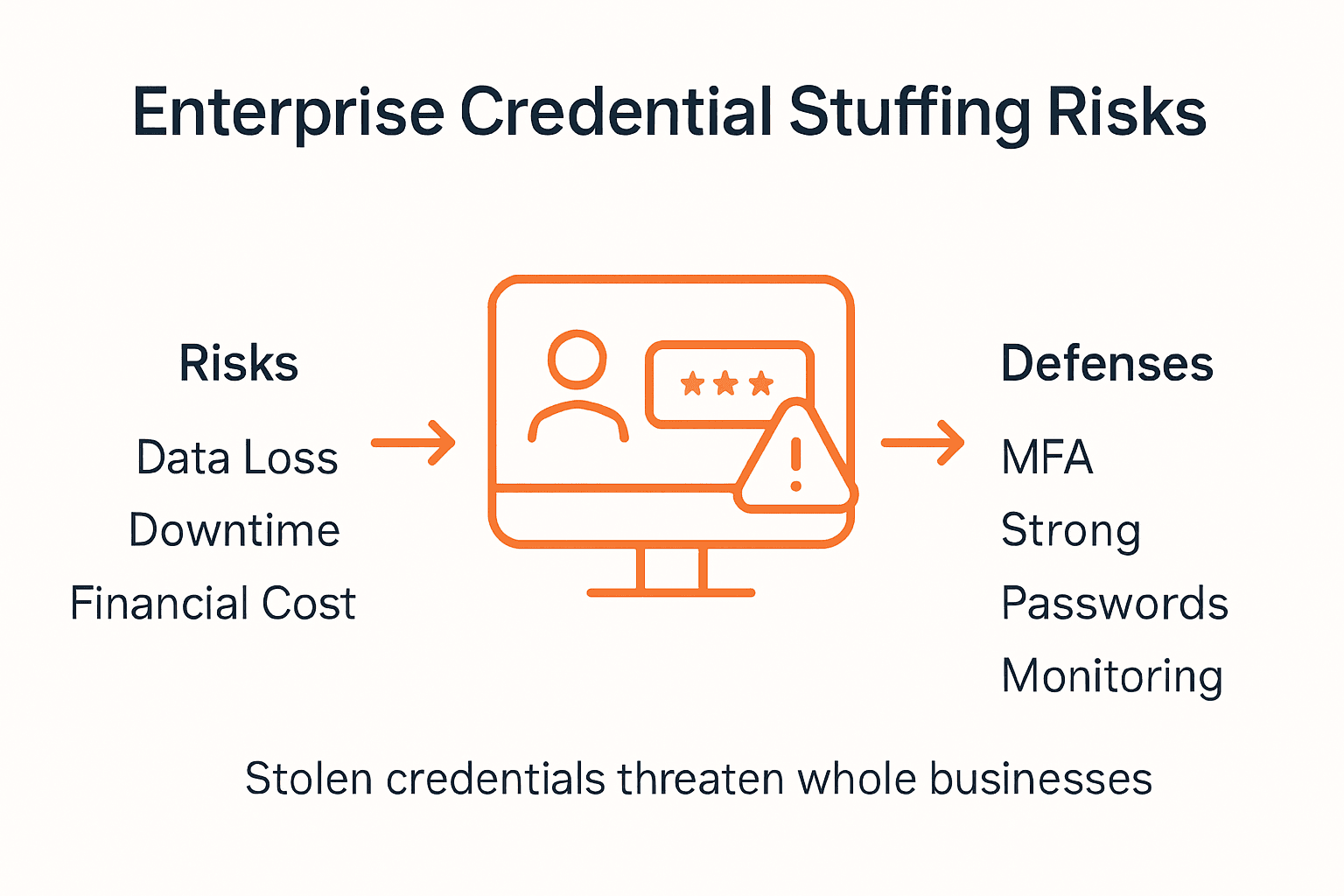
The multifaceted risks extend far beyond immediate financial implications. Successful credential stuffing attacks can provide cybercriminals with unauthorized access to sensitive corporate networks, enabling data breaches, intellectual property theft, and sophisticated lateral movement within organizational systems. Enterprise security teams must contend with the complex aftermath of these attacks, which often involve extensive forensic investigations, mandatory customer notifications, potential legal liabilities, and resource-intensive account recovery processes. The downstream effects can include significant productivity losses, increased cybersecurity infrastructure costs, and potential regulatory penalties for inadequate security measures.
Moreover, credential stuffing attacks create systemic vulnerabilities that ripple through entire industry ecosystems. When one enterprise experiences a breach, the compromised credentials can be leveraged against multiple platforms, creating a cascading effect of potential security compromises. Large organizations with extensive digital footprints become particularly attractive targets, as successful infiltration can provide attackers with valuable user data, corporate credentials, and potential pathways to more sophisticated cyber espionage activities. The interconnected nature of modern digital infrastructure means that a single successful credential stuffing attack can have far-reaching consequences that extend well beyond the initial point of compromise.
Pro Tip – Comprehensive Defense Strategy: Implement a holistic security approach combining advanced anomaly detection, mandatory multi-factor authentication, continuous credential monitoring, and robust employee cybersecurity awareness training to create multiple defensive layers against credential stuffing threats.
Detection, Prevention, and Security Strategies
Enterprise cybersecurity teams must deploy sophisticated, multilayered defense mechanisms to effectively combat credential stuffing threats. Organizations can implement comprehensive prevention strategies through advanced authentication protocols and anomaly detection techniques, creating robust barriers against automated login attacks. The most effective approaches integrate multiple defensive technologies that work synergistically to identify, interrupt, and prevent unauthorized access attempts before they can compromise sensitive systems.
Key defensive strategies include implementing advanced multi-factor authentication frameworks that require additional verification beyond traditional password entry. This might involve biometric validation, hardware security tokens, or contextual authentication that evaluates login characteristics such as geographic location, device fingerprinting, and historical user behavior patterns. Enterprises should also deploy sophisticated rate limiting mechanisms that detect and block high-velocity login attempts, preventing attackers from systematically testing large credential collections. Intelligent IP reputation tracking, geolocation-based access controls, and adaptive authentication protocols can significantly reduce the success probability of credential stuffing campaigns.
Cybersecurity professionals must also prioritize proactive threat intelligence and continuous monitoring capabilities. This involves maintaining constantly updated breached credential databases, implementing real-time login attempt analysis, and developing automated response protocols that can instantly quarantine suspicious access attempts. By combining machine learning algorithms with human-supervised threat detection, organizations can create dynamic security environments that adapt rapidly to emerging credential stuffing methodologies. Comprehensive security strategies should include periodic security awareness training, mandatory password rotation policies, and integration of advanced threat detection technologies that can identify subtle indicators of potential credential compromise.
Below is a summary table of essential enterprise defense measures against credential stuffing:
| Security Measure | Purpose | Example Implementation |
|---|---|---|
| Multi-factor authentication | Adds verification layer | SMS code or biometric scan |
| Rate limiting | Blocks rapid login attempts | Limit logins per IP per minute |
| Credential monitoring | Detects leaked credentials | Database of known breach data |
| Employee awareness training | Reduces risky behavior | Regular phishing simulations |
| Adaptive authentication | Analyzes user behavior | Location- or device-based checks |
Pro Tip – Adaptive Defense Protocol: Develop a comprehensive credential security framework that combines technological solutions with continuous employee education, ensuring a holistic approach to defending against sophisticated credential stuffing attacks.
Strengthen Your Enterprise Defense Against Credential Stuffing Today
Credential stuffing exploits reused passwords and stolen credentials to compromise critical enterprise systems. This stealthy threat can lead to devastating financial loss, damaged reputation, and unauthorized data access. If you recognize the urgent need to defend your organization from automated attacks that bypass traditional security methods you need a solution designed for modern challenges. LogMeOnce offers a comprehensive suite that combines passwordless multi-factor authentication, encrypted cloud storage, and real-time dark web monitoring to protect your digital identity seamlessly.

Explore how our innovative security features empower your team to stop credential stuffing attacks before they happen. Experience the power of single sign-on and adaptive authentication tailored to enterprises seeking bulletproof protection. Don’t wait until your accounts are compromised. Visit LogMeOnce now to secure your business and request your free trial today. Your digital defense starts here.
Frequently Asked Questions
What is credential stuffing?
Credential stuffing is a cyber attack method that uses stolen credentials from data breaches to gain unauthorized access to user accounts across multiple platforms. It exploits the common practice of password reuse among users.
How do credential stuffing attacks differ from brute force attacks?
Unlike brute force attacks that randomly generate password combinations, credential stuffing specifically utilizes actual stolen credentials from previous breaches to attempt logins. This increases the likelihood of success since attackers use real user information.
What are the potential impacts of a successful credential stuffing attack on an enterprise?
Successful credential stuffing attacks can lead to financial losses, data breaches, identity theft, operational disruptions, and damage to customer trust and brand reputation. They can also create regulatory compliance risks for businesses.
How can enterprises defend against credential stuffing attacks?
Enterprises can implement multi-factor authentication, employ rate limiting to block rapid login attempts, monitor for credential leaks, conduct employee cybersecurity training, and utilize adaptive authentication measures to enhance their security against credential stuffing threats.
Recommended
- The Finesses of Enterprise Password Management
- How an Enterprise Password Manager Augments Efficiency and Security
- Enterprise Password Management Mistakes You Don’t Want to Make
- 7 Cyber Threats That Target Small Business – LogMeOnce


