


 Password Manager
 Identity Theft Protection

 Team / Business
 Enterprise
 Government
 MSP
MSP


Password Sharing Risks Explained: Complete Guide

Did you know that over 64 percent of people admit to sharing their passwords with friends, family, or coworkers? This widespread habit might seem harmless, yet it opens the door to serious privacy breaches and security headaches. Understanding the risks and key concepts behind password sharing can help protect your personal data and keep your digital accounts safe from threats lurking online.
Key Takeaways
| Point | Details |
|---|---|
| Password Sharing Risks | Sharing passwords introduces significant security vulnerabilities that can lead to data breaches and unauthorized access. |
| Legal and Compliance Issues | Password sharing can result in legal risks, including violations of data protection regulations and organizational policies. |
| Cybersecurity Threats | Shared credentials elevate the risk of identity theft, credential stuffing, and persistent unauthorized access to systems. |
| Secure Alternatives Essential | Implementing advanced authentication methods, such as multi-factor authentication and passwordless solutions, enhances security and reduces risks associated with password sharing. |
What Is Password Sharing? Key Concepts
Password sharing is the practice of deliberately or unintentionally revealing login credentials with another person, granting them access to a protected digital account or system. While sometimes done with good intentions, this behavior introduces significant security vulnerabilities and potential risks across personal and professional environments.
According to Wikipedia’s communication privacy management theory, password sharing represents a complex decision-making process where individuals negotiate the boundaries of private information disclosure. This theory suggests that people weigh various factors when deciding whether to share sensitive access credentials, including trust, perceived benefits, and potential consequences.
Password sharing can manifest in multiple contexts:
- Workplace collaboration where team members exchange login details
- Family members sharing streaming service accounts
- Friends sharing social media or gaming platform credentials
- Remote workers accessing shared organizational resources
The core problem with password sharing lies in its fundamental breach of digital security principles. When multiple individuals possess login information, the ability to track, control, and audit account access becomes significantly compromised. This practice creates what cybersecurity experts call a “diffused responsibility” scenario, where no single person can be held accountable for potential security breaches.
Interestingly, Wikipedia’s secret sharing research provides an alternative perspective, noting that sophisticated secret sharing techniques can distribute access without compromising overall security. However, casual password sharing among individuals lacks these sophisticated cryptographic protections, making it inherently risky.
For individuals and organizations seeking to understand the nuanced risks, our guide on secure password sharing steps offers comprehensive insights into managing collaborative access safely.
Common Password Sharing Scenarios Explored
Password sharing occurs in numerous contexts, each presenting unique security challenges and potential risks. While seemingly harmless, these scenarios can expose individuals and organizations to significant digital vulnerabilities that extend far beyond simple credential exchange.
According to ArXiv research, a striking 64.35% of participants admitted feeling compelled to share their email passwords, typically with friends, colleagues, or romantic partners. This widespread practice reveals a troubling disconnect between perceived convenience and actual security implications.
Common Password Sharing Scenarios include:
- Streaming Service Accounts: Sharing Netflix, Hulu, or Disney+ login credentials
- Work Collaboration: Team members exchanging project management tool access
- Family Sharing: Parents monitoring children’s online activities
- Relationship Dynamics: Partners sharing social media or personal email accounts
- Educational Settings: Students collaborating on shared academic platforms
The interconnected nature of digital platforms amplifies these risks. ArXiv research highlights that users frequently reuse passwords across multiple services, which means a single shared password can potentially compromise numerous accounts simultaneously.
Here’s a comparison of common password sharing scenarios and their associated risks:
| Scenario | Typical Participants | Main Risks |
|---|---|---|
| Streaming Service Accounts | Family Friends |
Account lockout Billing issues Privacy loss |
| Work Collaboration | Coworkers Project teams |
Data breaches Audit challenges Policy violations |
| Family Sharing | Parents Children |
Privacy invasion Unintended access Loss of control |
| Relationship Dynamics | Partners Significant others |
Identity theft Loss of privacy Trust issues |
| Educational Settings | Students Classmates |
Cheating Unauthorized changes Account compromise |
These scenarios demonstrate that password sharing is rarely a simple, isolated action. Each instance creates a cascading potential for security breaches, identity theft, and unauthorized access.
 While the intentions might be trust-based or practical, the potential consequences can be devastating.
To better understand how to mitigate these risks, our guide on essential password management tips offers comprehensive strategies for maintaining robust digital security.
Cybersecurity Threats From Shared Credentials
Shared credentials represent a critical vulnerability in digital security, creating multiple entry points for potential cyber attacks and unauthorized access. The seemingly innocent act of sharing login information can trigger a cascade of sophisticated cybersecurity risks that compromise individual and organizational digital infrastructure.
ArXiv research reveals that password reuse and sharing can lead to targeted brute-force attacks, where malicious actors exploit shared credentials to systematically gain unauthorized system access. These attacks are particularly dangerous because they leverage the interconnected nature of modern digital platforms.
Key Cybersecurity Threats Include:
- Credential Stuffing: Using leaked passwords across multiple platforms
- Identity Theft: Unauthorized individuals gaining comprehensive personal access
- Data Breach Escalation: One compromised account potentially exposing multiple systems
- Social Engineering: Exploiting trust relationships inherent in password sharing
- Persistent Unauthorized Access: Maintaining long-term system infiltration
According to ArXiv research, the risks intensify when shared credentials are stored or transmitted through insecure channels. This vulnerability creates multiple potential points of interception, where cybercriminals can capture login information with relative ease.
The threat landscape extends beyond immediate account compromise. Shared credentials can become sophisticated attack vectors, allowing persistent access that may go undetected for extended periods. Each shared password represents a potential bridge for cybercriminals to navigate through personal and professional digital ecosystems.
To protect against these evolving threats, our guide on password security tips provides comprehensive strategies for maintaining robust digital defense mechanisms.
Legal, Compliance, And Privacy Implications
Password sharing represents a complex legal and ethical minefield, extending far beyond simple technological concerns. The act of sharing credentials introduces significant legal risks that can compromise individual privacy, organizational security, and potential regulatory compliance violations.
Wikipedia’s communication privacy management theory provides critical insight into the intricate decision-making processes surrounding private information disclosure. This framework highlights how individuals and organizations must carefully navigate the delicate balance between collaborative access and potential legal vulnerabilities.
Key Legal and Compliance Considerations Include:
- Contractual Breaches: Violating organizational security policies
- Data Protection Regulations: Potential non-compliance with GDPR, HIPAA, or other privacy laws
- Intellectual Property Risks: Unauthorized access to sensitive corporate information
- Employment Law Implications: Potential grounds for workplace disciplinary action
- Liability for Security Incidents: Potential financial and legal repercussions
Social Penetration Theory further illuminates the complex dynamics of information sharing, demonstrating how seemingly harmless credential exchanges can create significant legal and ethical challenges. The theory emphasizes the critical balance between transparency and protecting sensitive information.
In professional environments, password sharing can trigger substantial legal consequences. Organizations may face significant financial penalties, reputational damage, and potential litigation if shared credentials lead to data breaches or unauthorized information access. The legal landscape continues to evolve, with increasing regulatory scrutiny on digital security practices.
To understand the nuanced legal landscape of digital security, our IT staffing and consulting resources offer comprehensive insights into navigating these complex compliance challenges.
Real-World Impacts For Individuals And Organizations
Password sharing transforms from a seemingly innocuous convenience into a potentially devastating security vulnerability that can unravel personal and professional digital ecosystems within moments. The ripple effects of credential sharing extend far beyond simple unauthorized access, creating complex and long-lasting consequences for both individuals and organizations.
ArXiv research from the ChaMAILeon study reveals critical usability challenges and privacy concerns inherent in password sharing. These findings underscore the intricate balance between convenience and security that individuals and organizations must carefully navigate.
Real-World Consequences Include:
- Personal Financial Loss: Identity theft and unauthorized transactions
- Professional Reputation Damage: Loss of trust and credibility
- Career Jeopardy: Potential termination for security policy violations
- Intellectual Property Exposure: Unauthorized access to sensitive information
- Regulatory Compliance Violations: Potential legal and financial penalties
ArXiv research highlights the profound security risks organizations face when employees share or reuse passwords across multiple platforms. This practice creates intricate vulnerability networks that malicious actors can systematically exploit, transforming seemingly minor credential sharing into significant institutional risks.
Individuals might share passwords believing they’re helping a friend or improving workplace collaboration, but the potential consequences can be catastrophic. A single shared credential can become a gateway for comprehensive digital infiltration, potentially compromising entire personal and professional networks in ways that are difficult to predict or contain.
To develop a comprehensive understanding of these complex dynamics, our guide on password security tips provides critical insights into protecting digital ecosystems from these pervasive risks.
Secure Alternatives To Password Sharing
Password sharing represents an outdated and dangerous approach to collaborative access, with modern cybersecurity strategies offering sophisticated alternatives that maintain both security and convenience. These innovative solutions eliminate the risks associated with traditional credential exchange while preserving the core need for collaborative digital interactions.
Wikipedia’s Secure Remote Password protocol introduces groundbreaking authentication methods that allow users to verify identity without transmitting passwords. This approach fundamentally transforms how access and authentication are managed, creating secure pathways that protect sensitive information.
Secure Alternatives Include:
- Multi-Factor Authentication: Requiring multiple verification steps
- Role-Based Access Control: Granular permissions management
- Temporary Access Tokens: Time-limited credential sharing
- Single Sign-On Solutions: Centralized, secure authentication
- Passwordless Authentication: Biometric or device-based verification
ArXiv research highlights the potential of secret sharing schemes like Shamir’s Secret Sharing, which provide sophisticated methods for authentication without directly sharing passwords. These cryptographic techniques distribute access authentication across multiple components, making unauthorized access exponentially more difficult.
Organizations and individuals can dramatically reduce security risks by implementing these advanced authentication strategies.
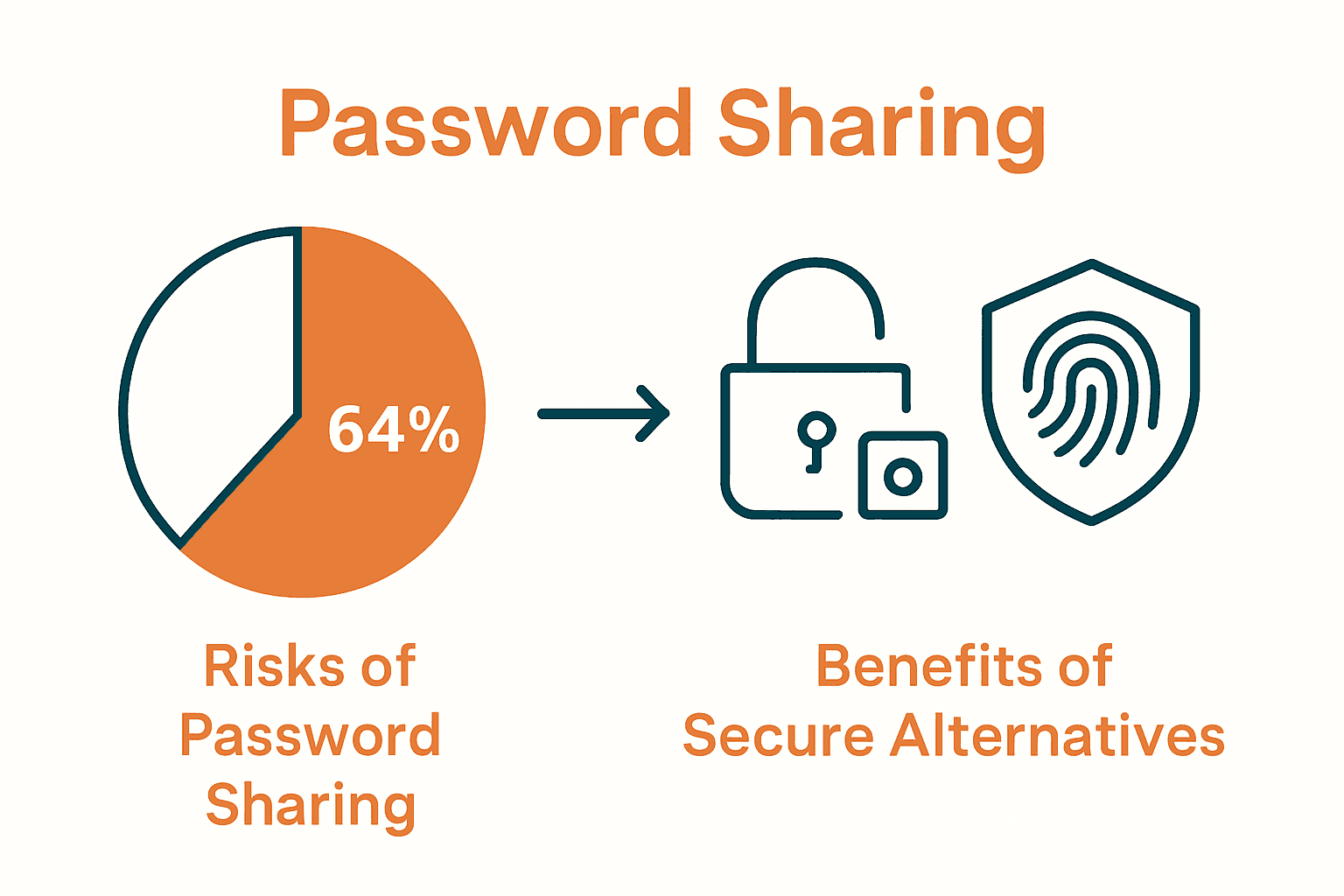 Instead of sharing static passwords, these approaches create dynamic, context-aware access mechanisms that adapt to specific security requirements and user needs.
To explore cutting-edge approaches to secure access, our examples of passwordless solutions provide comprehensive insights into next-generation authentication technologies.
Protect Your Digital World from the Hidden Dangers of Password Sharing
Password sharing may seem like a simple way to collaborate or stay connected, but it introduces serious risks like identity theft, data breaches, and compromised privacy. The article reveals how sharing passwords creates a “diffused responsibility” that puts your personal and professional security at stake. If you want to stop worrying about unauthorized access and regain control, it is critical to adopt smarter, more secure identity management solutions.
Take charge of your digital security today with LogMeOnce and explore our advanced features such as multi-factor authentication and single sign-on that eliminate the need for risky password sharing. Learn how to replace vulnerable shared credentials with robust, easy-to-use authentication methods by visiting our passwordless solutions page. Don’t wait until it’s too late. Start your free trial now and secure your accounts with industry-leading protection designed for individuals and organizations who value privacy and compliance.
Discover how to stay ahead of cyber threats with LogMeOnce Resources and transform your approach to password security immediately.
Frequently Asked Questions
What is password sharing and why is it risky?
Password sharing is the act of sharing login credentials for a digital account or service with others. It is risky because it compromises digital security by making it difficult to track who has access to the account, increasing the chance of unauthorized use, data breaches, and identity theft.
What are common scenarios where password sharing occurs?
Common scenarios for password sharing include sharing streaming service credentials among family and friends, coworkers exchanging access to work tools, and family members sharing accounts for monitoring children’s online activities.
How can password sharing lead to cybersecurity threats?
Password sharing can lead to cybersecurity threats such as credential stuffing, where attackers use shared passwords for unauthorized access across multiple platforms. It can also facilitate identity theft and persistent unauthorized access due to weak security practices surrounding shared credentials.
What are some secure alternatives to password sharing?
Secure alternatives to password sharing include using multi-factor authentication, role-based access control, temporary access tokens, single sign-on solutions, and passwordless authentication methods, which enhance security while allowing for collaborative access.


